Philippikos (711–13)
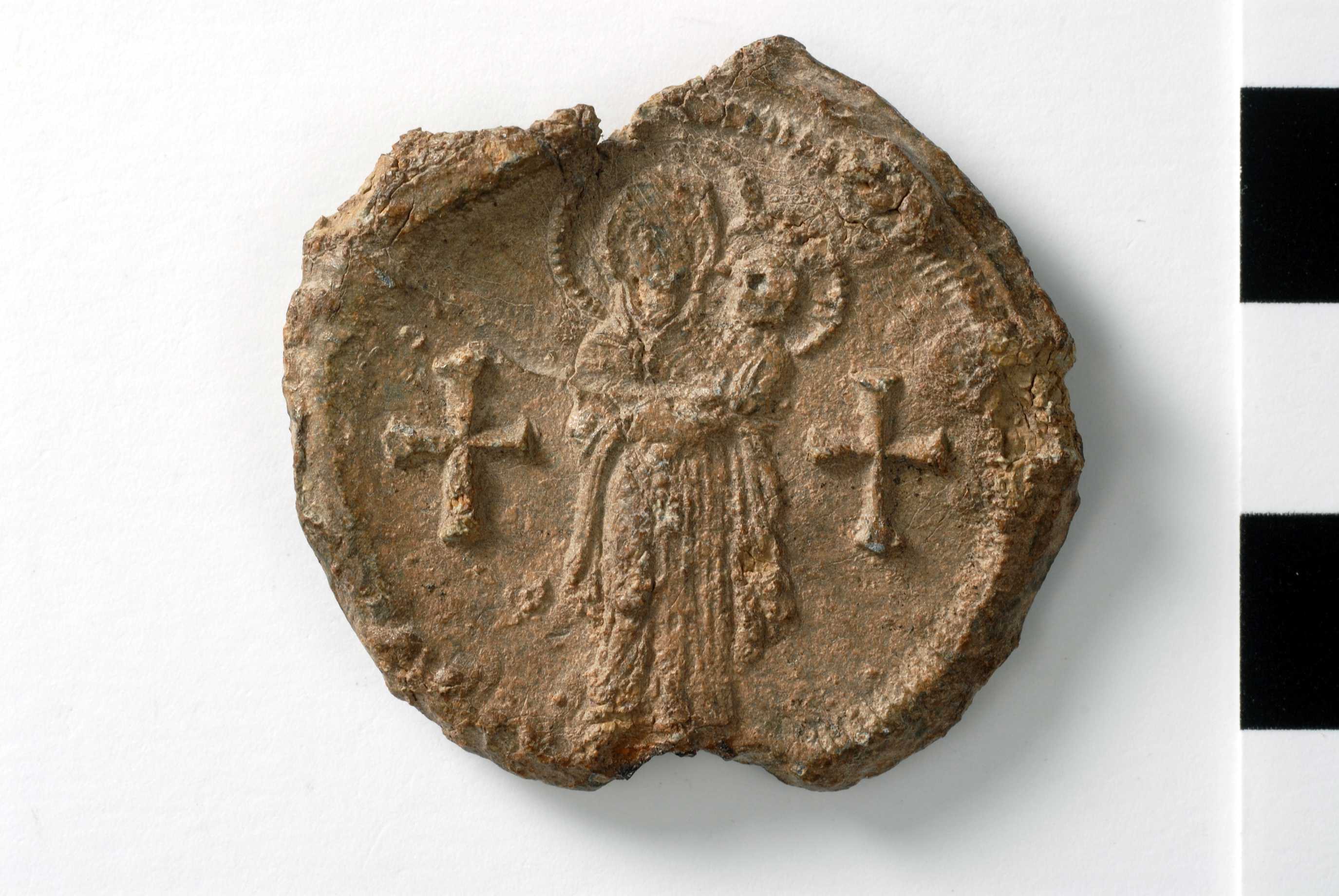
Obverse
The Mother of God standing, wearing a chiton and maphorion, and holding Christ on her left arm. A cross potent at left and right. Wreath border.
Reverse
Half-length representation of Philippikos, with a short beard and mustache, wearing a crown with a cross and a loros, and holding a globus cruciger in his right hand and in his left a staff topped by an eagle. His hair is worn long at the sides, and his sidelocks are combed downward and curled at bottom. Circular inscription beginning at left. Wreath border.
DNFILEPICS...TSAN
D(ominus) n(oster) Filepicus [mul]tus an(nus?).
Obverse
The Mother of God standing, wearing a chiton and maphorion, and holding Christ on her left arm. A cross potent at left and right. Wreath border.
Reverse
Half-length representation of Philippikos, with a short beard and mustache, wearing a crown with a cross and a loros, and holding a globus cruciger in his right hand and in his left a staff topped by an eagle. His hair is worn long at the sides, and his sidelocks are combed downward and curled at bottom. Circular inscription beginning at left. Wreath border.
DNFILEPICS...TSAN
D(ominus) n(oster) Filepicus [mul]tus an(nus?).
| Accession number | BZS.1958.106.597 (formerly DO 58.106.597) |
|---|---|
| Diameter | 37.0 mm |
| Previous Editions | DO Seals 6, no. 27.1; Zacos–Veglery, no. 30a. |
Translation
Dominus noster Filepicus multus annus.
Our lord Philippikos, [reign] many years.
Bibliography
- Catalogue of Byzantine Seals at Dumbarton Oaks and in the Fogg Museum of Art, Vol. 6, Emperors, Patriarchs of Constantinople, Addenda (Open in Zotero)
- Byzantine Lead Seals, Vol. 1 (Open in Zotero)
- Catalogue of the Byzantine Coins in the Dumbarton Oaks Collection and in the Whittemore Collection, Vol. 2, Phocas to Theodosius III (602–717) (Open in Zotero)
- Moneta Imperii Byzantini: Rekonstruktion des Prägeaufbaues auf synoptisch-tabellarischer Grundlage (Open in Zotero)
Commentary
The inclusion of an identifying inscription on imperial seals was revived during Justinian II’s second reign, a practice that was continued in Philippikos’s chancery. There is a striking similarity between gold coins and seals in both the quality of craftsmanship and figure modeling (for example, DOC 2.2:1h; MIB 3, Prägetabelle 15, nos. 1–4). The Mother of God continues to be depicted on the seals, but on the emperor’s solidi Christ’s bust is replaced with a cross-on-steps.